
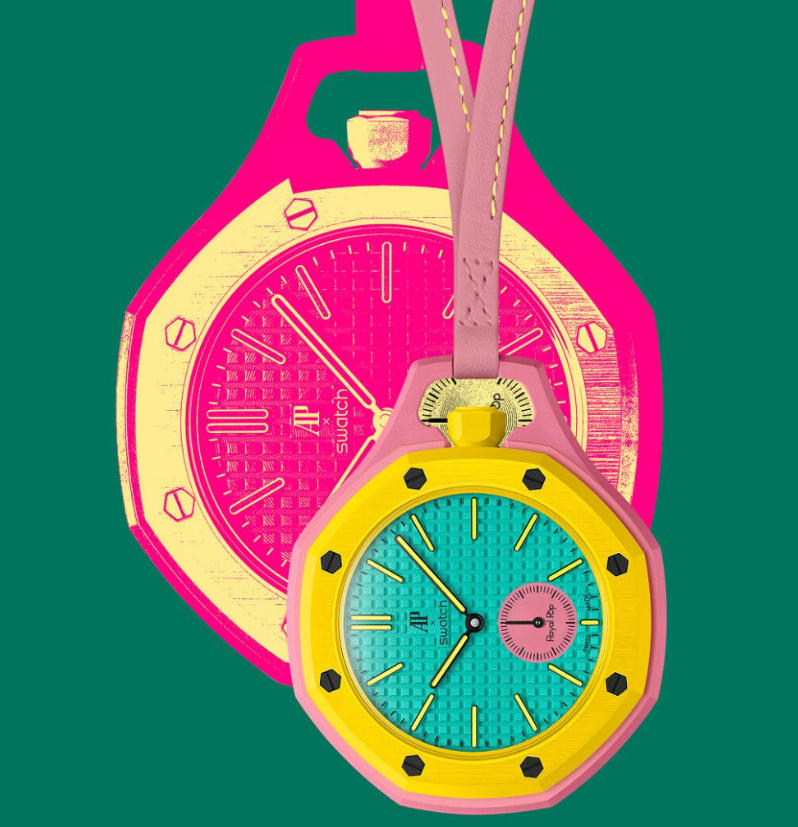
When Audemars Piguet and Swatch revealed the Royal Pop in May, the easiest prediction was that it would look like a cheaper Royal Oak for the wrist. That would have followed a familiar formula after the MoonSwatch. Instead, the two brands did something considerably stranger: they turned some of the Royal Oak’s most recognisable ideas into a colourful mechanical pocket watch. A few months later, that decision still feels like the most interesting part of the project. The Royal Pop is not trying to pass itself off as an affordable Royal Oak, nor does it make much sense as a conventional alternative to one. It works because it takes familiar details and puts them into a format that is deliberately less serious. For us at UK replica watches, that makes the collaboration particularly interesting. HiReplicas covers Rolex, Omega, Breitling, TAG Heuer, Patek Philippe, Hublot and Audemars Piguet rather than concentrating on a single name, so unusual releases like this help show which elements of a famous watch remain recognisable even when almost everything else changes.
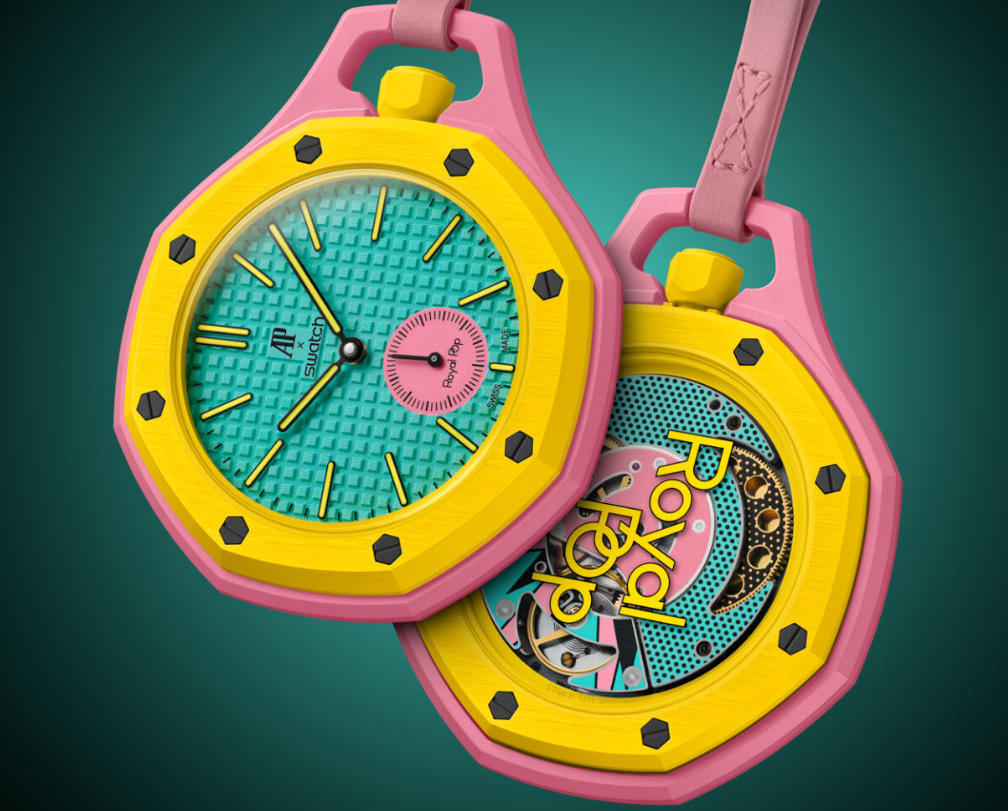
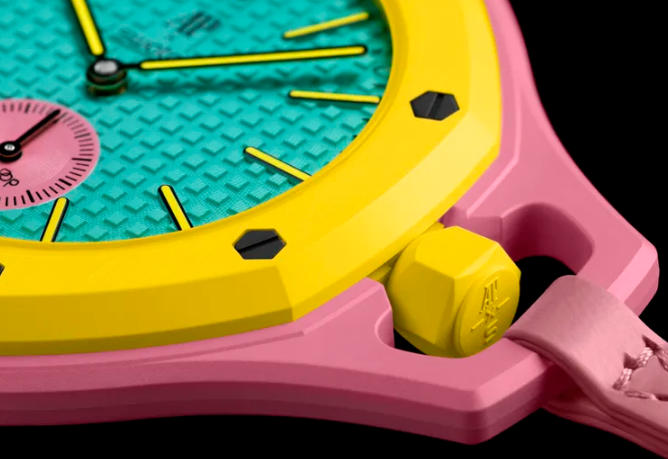
The Royal Oak influence is obvious without needing an AP logo explained to you. The octagonal bezel, eight exposed screws and textured dial immediately bring the Royal Oak to mind. Yet the Royal Pop does not simply shrink those details into a conventional Swatch case. The watch is built to be carried, hung from a lanyard, attached to a bag or placed on a stand. That difference matters. Plenty of collaborations rely on a well-known case shape and a new colour scheme. Here, the unusual format forces you to look again at the design itself. Strip away the integrated bracelet, steel case and luxury finishing and the Royal Oak still remains surprisingly easy to recognise. For anyone following Royal Oak inspired watches in the UK, that says quite a lot about how powerful Gérald Genta’s original visual language has become.
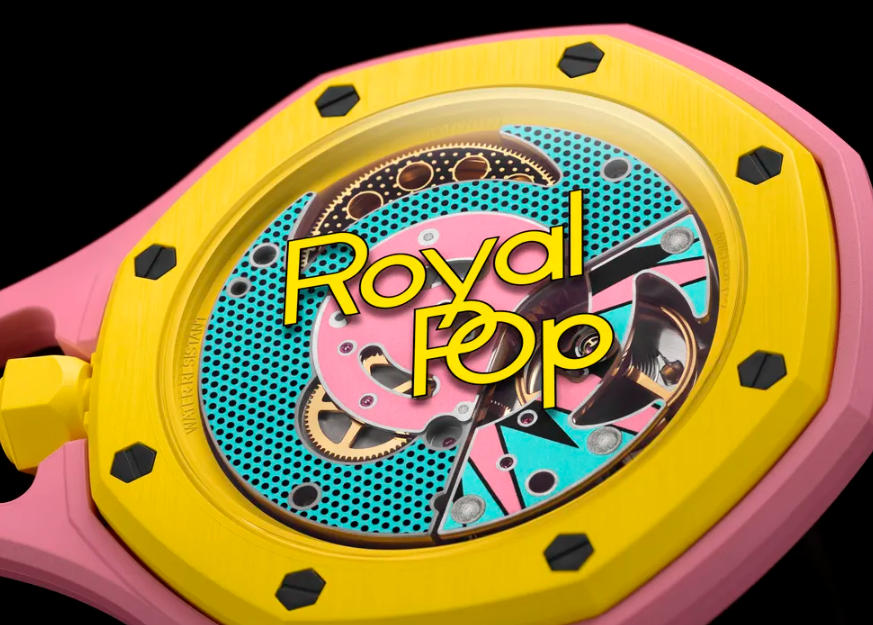
The Royal Pop collection contains eight versions, all playing with bright colour rather than the restrained steel-and-blue combination most people first associate with the Royal Oak. Swatch uses its Bioceramic material for the cases, combining ceramic with a biosourced component derived from castor oil. The result looks and feels much more like modern Swatch than traditional Audemars Piguet, which is exactly how it should be. There is also more mechanical interest here than the playful appearance initially suggests. Inside sits a new hand-wound version of Swatch’s SISTEM51 movement. It offers more than 90 hours of power reserve and uses a Nivachron balance spring. Turning SISTEM51 into a manual-winding movement makes sense for a watch that may spend much of its life hanging from a lanyard or sitting on a desk rather than moving around on a wrist. I actually prefer that choice to an automatic movement. Winding a pocket watch by hand gives the owner a reason to interact with it. The Royal Pop is already an odd object by modern standards, so making the mechanical experience slightly old-fashioned suits it better than pretending it is just another sports watch. The two basic layouts also acknowledge traditional pocket-watch formats. Most of the collection follows a Lépine-style arrangement, while two versions use a Savonnette-style position and small seconds. Those details probably will not be the reason most people buy one, but they stop the Royal Pop from feeling like a novelty shell with an AP-shaped bezel glued on top.
What nobody could ignore was the reaction when the watches actually reached stores on 16 May. The launch drew long queues around the world, including London, where crowds gathered around Swatch locations and several UK stores were temporarily closed because of safety concerns. That response showed that the collaboration had moved beyond normal watch enthusiasts almost immediately. There was also the inevitable resale speculation. That side of modern watch culture is much less appealing. A watch designed to make mechanical watchmaking more playful becomes harder to appreciate when the conversation is dominated by who queued first and how much somebody can flip it for. Swatch has since made clear that Royal Pop production is continuing for months, which is worth remembering before treating one as an artificially rare collector’s item.
From a UK enthusiast’s perspective, the more lasting question is whether people will still care about the Royal Pop after the launch noise fades. I think some will. Not because it gives them a cheap route into Audemars Piguet ownership — it does not — but because it is an unusual object with enough mechanical and design thinking behind it to survive after the hype. It also creates an interesting comparison for readers who follow Audemars Piguet replica watches. The replica market normally attempts to move towards the original watch, reproducing familiar proportions, dials, bezels and bracelets as closely as possible. Royal Pop moves in the opposite direction. It deliberately removes much of what makes a conventional Royal Oak luxurious while proving that a handful of visual cues are enough for people to recognise the source immediately. That is why Audemars Piguet Royal Oak design details matter more than simply putting an AP-style name on a product. The octagonal geometry, screw arrangement and dial texture carry an enormous amount of the identity. This is just as relevant when looking at the UK Audemars Piguet replica watch market, where visual accuracy can vary significantly between watches that appear similar at first glance.
There is another reason the Royal Pop feels relevant to a broader replica-watch site. Watch buyers increasingly move between very different price levels. Someone may admire an original Royal Oak, own a Swatch, read about replica watches and still enjoy vintage mechanical pieces. Those interests are no longer as neatly separated as the traditional watch industry sometimes assumes. The Royal Pop leans directly into that reality. It takes one of the most exclusive shapes in modern watchmaking and turns it into something colourful, playful and relatively approachable without pretending the result is the original thing. That distinction gives the collaboration more personality than a straightforward plastic Royal Oak would have had. I still would not call it an obvious everyday watch. Carrying a mechanical watch around your neck or clipping it to a bag will feel natural to some people and ridiculous to others. But that disagreement is part of the appeal. Watches have spent years getting safer, more familiar and more commercially predictable. Royal Pop at least gives people something genuinely odd to argue about. For UK replica watch collectors comparing famous Swiss designs, the useful lesson is not that every unusual collaboration deserves to become collectible. It is that strong watch design can remain identifiable even after the materials, price, wearing style and manufacturing approach have all changed. Months after the initial queues, that is what I find most memorable about Royal Pop. The hype will eventually settle. The resale premiums may disappear. But the fact that Swatch and Audemars Piguet turned the Royal Oak into a bright mechanical pocket watch — and somehow made it instantly recognisable — is unlikely to become boring quite as quickly.