
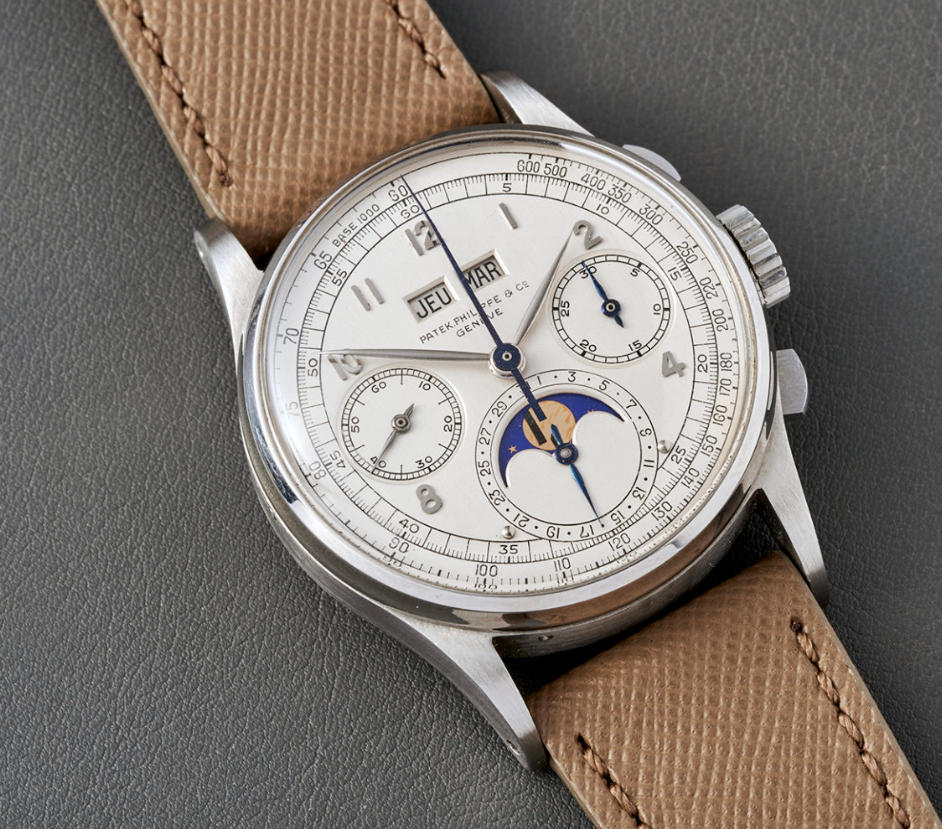
There is something slightly strange about looking at a Patek Philippe Ref. 1518 in stainless steel and knowing what it has become.From across a room, it does not behave like an eight-figure watch. There is no oversized case, no elaborate gem setting and none of the visual theatre associated with many modern collector pieces. It measures roughly 35mm across, sits quietly on a leather strap and, at first glance, could easily be mistaken for an elegant mid-century chronograph.That understatement is precisely what makes it fascinating.The stainless steel Patek Philippe Ref. 1518 is not important because somebody recently decided it was rare. Its reputation comes from a combination of technical history, extremely limited production and the almost absurd contrast between its modest appearance and its place at the top of the vintage-watch market.
The 1518 Was Important Before Anyone Talked About Auction Records
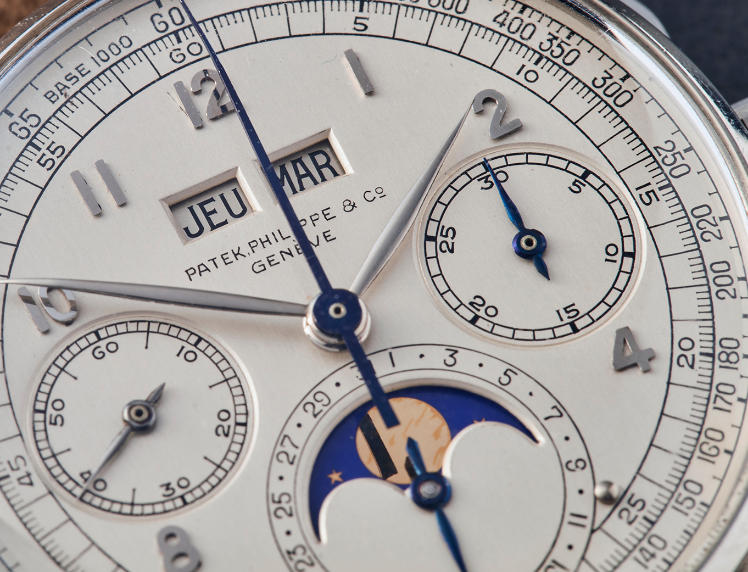
Patek Philippe introduced the Ref. 1518 in 1941, at a time when complicated wristwatches were still far less common than they are today. Its defining achievement was straightforward to describe but extraordinarily difficult to execute: it combined a chronograph with a perpetual calendar in a wristwatch produced as a regular series.That made it the first serially produced perpetual calendar chronograph wristwatch.The distinction matters because the basic formula established by the 1518 did not disappear when production ended. Day and month windows sit together beneath 12 o’clock, chronograph and running-seconds registers occupy either side of the dial, while the date and moon phase share the lower portion.Versions of that layout would continue through later Patek Philippe references including the 2499, 3970, 5970 and eventually the modern 5270.For collectors interested in a vintage Patek Philippe perpetual calendar chronograph, the 1518 therefore represents more than an early reference number. It is the point from which one of Patek Philippe’s most recognisable families developed.
Then There Is the Question of Steel
Patek Philippe produced approximately 281 examples of the Ref. 1518 across its production run. Most were made in yellow gold, with a much smaller group in pink gold.Only four stainless-steel examples are publicly known.That figure changes the character of the watch completely.Today, stainless steel is everywhere in expensive watchmaking. Some of the most sought-after watches in the world are steel sports models. In the 1940s, however, the material carried a very different meaning. A highly complicated Patek Philippe would ordinarily have been expected to wear a precious-metal case.Putting the 1518 into steel therefore created an unusual contradiction. The movement and complication represented some of the finest watchmaking available, while the case material was comparatively functional and ordinary.It is one reason rare steel Patek Philippe watches tend to attract such intense attention. Their appeal is not simply that fewer were made. They also sit slightly outside the normal logic of the brand’s period production.
The First Known Steel Example Has Its Own Story
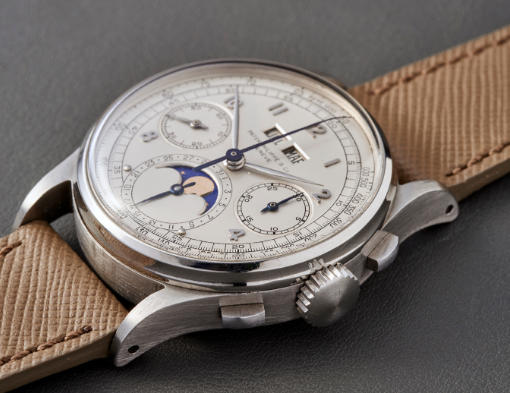
The watch that returned to Phillips in Geneva in 2025 was manufactured in 1943. Its case carries the number 508’473, accompanied by a small “1” that identifies it as the first of the known steel examples from that sequence.It was subsequently sold through Joseph Lang in Budapest in February 1944.That history gives the watch a context that is difficult to separate from the object itself. This was not a modern limited edition announced through a carefully managed launch campaign. It was an extraordinarily complicated Swiss wristwatch moving through Europe during the Second World War.More than eighty years later, it survives with the kind of detail collectors spend years learning to recognise.The 35mm steel case was made by Georges Croisier. Rather than looking soft and heavily refinished, the example offered in 2025 retained clearly defined case geometry and unusually strong surfaces for a watch of its age.On a modern wrist, the 35mm Patek Philippe Ref. 1518 feels genuinely small. That is worth acknowledging rather than trying to make the dimensions sound contemporary. Anyone accustomed to a 40mm sports watch will immediately notice the difference.But the size is also part of the charm. The 1518 does not need to dominate the wrist to feel significant. In fact, much of its personality comes from doing the opposite.
A Dial That Explains More Than the Case
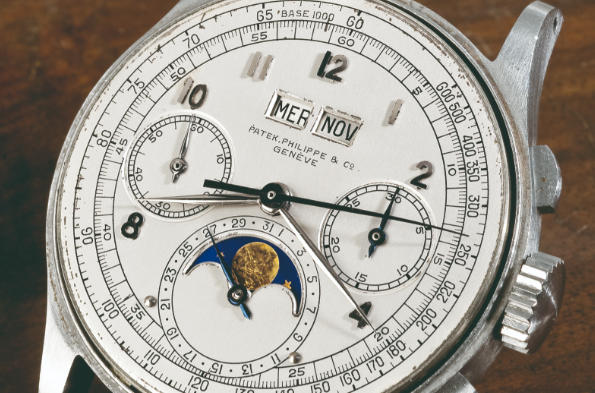
The dial is where the 1518 starts to make sense as something more than a rare steel object.There is a considerable amount of information packed into a relatively small space, yet it never feels chaotic. The day and month apertures create a clear horizontal line across the top. The two registers balance each other visually, while the moon phase and date bring weight to the lower section.A tachymeter scale sits around the outer edge without overwhelming the main indications.That balance is easy to overlook because modern watch photography allows us to zoom into every printed detail. On the wrist, however, the success of the design is more obvious. Information appears where you expect it to be, and the eye can move around the dial without getting lost.The 1943 steel example also retains the kind of enamel work and period finishing that cannot be understood simply by reading a specification sheet. Small variations in printing, ageing and hand-finished components are part of what separates an important vintage watch from a modern recreation of the same look.
The Movement Was Serious Watchmaking, Not Decoration
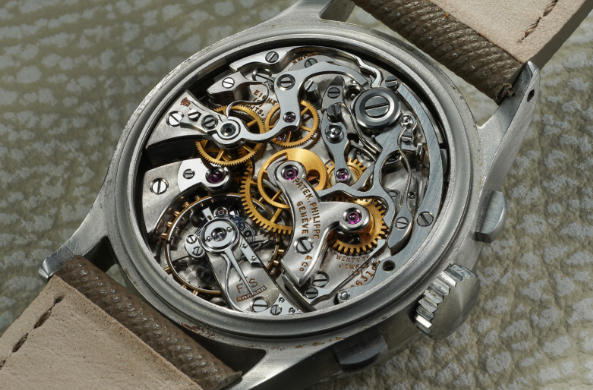
Inside the Ref. 1518 sits a manually wound perpetual-calendar chronograph movement based on a Valjoux chronograph architecture and extensively developed for Patek Philippe’s requirements.That matters because the 1518 predates the era in which brands could build a heritage story around an old reference and then reproduce its appearance with modern manufacturing.The complication had to work mechanically in a compact wristwatch case, keeping track of the calendar while also operating as a traditional chronograph.Its significance is therefore not created by rarity alone. Even if every steel example had disappeared, the Ref. 1518 would still have an important place in watchmaking history because of what the original model accomplished.
The 2016 Record Was Only Part of the Story
The first steel example became famous well outside specialist Patek Philippe collecting circles in November 2016.Phillips sold it in Geneva for CHF 11,002,000. At the time, the result made it the most expensive wristwatch ever sold at auction and the first wristwatch to cross the eight-figure mark at auction.For years, that number became attached to almost every discussion of the watch.Then it came back.In November 2025, the same 1943 steel Ref. 1518 returned to Phillips as part of its Decade One Geneva sale. This time it achieved CHF 14,190,000, equivalent to roughly US$17.63 million at the time.The result established a new auction record for a vintage Patek Philippe wristwatch.Those figures are extraordinary, but focusing only on price risks making the watch less interesting rather than more. The more revealing part of the Patek Philippe Ref. 1518 auction history is that collectors remained willing to compete for the same object nearly a decade after its first headline-making result.The market changed considerably between 2016 and 2025. Tastes shifted, prices rose and fell, and countless watches were temporarily promoted as the next great collectible. The steel 1518 did not need to be reinvented to remain important.
What Can UK Watch Enthusiasts Actually Take From It?
Most people reading about a steel 1518 will never buy one. That is not a problem.One of the odd habits of modern watch coverage is the idea that every article needs to finish by deciding whether a watch represents good value or whether somebody should purchase it. A Ref. 1518 does not need that kind of conclusion.For UK enthusiasts, its value is partly educational. It shows how proportions, dial balance, case construction and historical context can matter more than simple specifications.At HiReplicas UK replica watch site, we regularly look at modern and vintage watches because original designs provide the reference point for everything that follows in the wider replica market. Understanding why an original becomes important is far more useful than simply recognising the logo on its dial.The same applies when browsing our coverage of Patek Philippe replica watches. A watch can imitate the broad appearance of a famous reference without recreating the qualities collectors actually respond to.With the 1518, those qualities include the compact case, the relationship between the calendar displays and chronograph registers, the proportion of the bezel, the shape of the lugs and, perhaps most importantly, the sense that everything has a reason for being there.
Why the Steel 1518 Still Feels Surprisingly Modern
There is a temptation to describe any important vintage watch as “timeless”. The word is used so often that it has almost stopped meaning anything.The Ref. 1518 is more interesting than that.It actually looks old. Its dimensions are old-fashioned. The pushers, typography and dial architecture clearly belong to another period. Nothing about it needs to pretend otherwise.What still feels modern is the restraint.The steel case does not advertise its value. The dial has complexity without unnecessary decoration. The size allows the watch to sit quietly rather than turning it into a piece of wrist architecture.That combination can feel refreshing in a market where rarity is often announced with special colours, oversized cases and elaborate launch stories.The Ref. 1518 became rare without being designed to look rare.
A Record Price Is Not the Reason to Remember It
CHF 14.19 million is the sort of number that inevitably dominates headlines. Years from now, another watch may eventually exceed it and the rankings will change again.The historical importance of the Ref. 1518 will not.It arrived in 1941 as a genuine technical milestone. Only a tiny number were ever made in steel. The first known steel example survived for more than eight decades and has now passed through two landmark auctions.Yet it remains a small, restrained wristwatch that would attract little attention from anyone who did not already know what they were looking at.That may be the best explanation for the steel 1518’s enduring appeal.It does not look like a trophy until you understand it.